
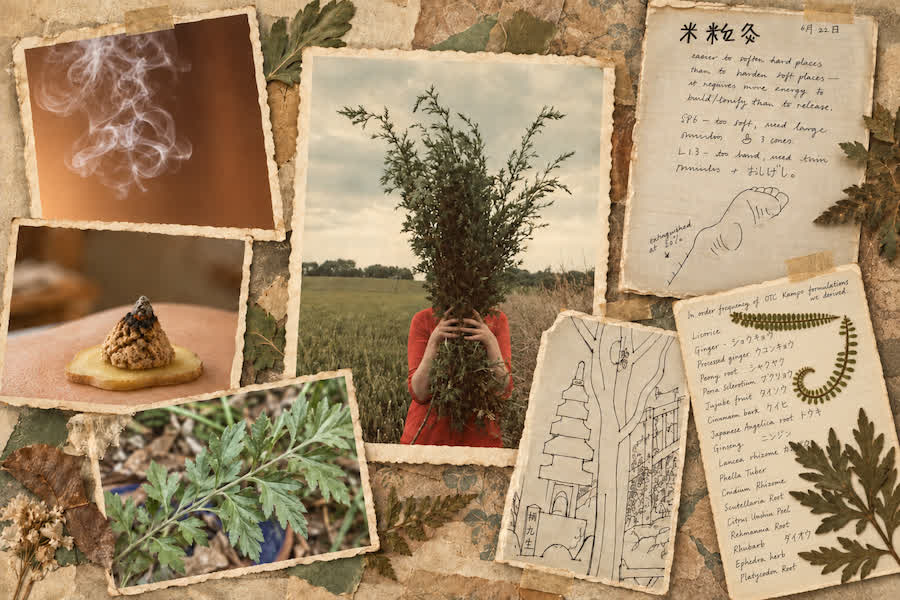




We often imagine a medicine as one standardized thing: a single technique, a single explanation. But spend time where moxa is actually practiced, and the picture becomes richer and far less uniform.
In this conversation, Hannah Swift returns to Qiological to share what she learned in Japan. A language school visa grew into a network of practitioners, foragers, and dyers who showed her that mugwort reaches well beyond the clinic: into food, the bath, seasonal festivals, and daily self-care.
This is not moxa as a standardized intervention. It is moxa as a living cultural practice, shaped by season, place, and the personality of each practitioner. A practitioner’s style is not a flaw to be corrected but part of the medicine.
Nourish your colleague relationships like they are the most precious plants, water them regularly.

Hannah Swift
I’m interested in diversity in bodywork practices and philosophies, this probably started when I was about 4 and I learned about reflexology in a workshop. I like the ways in which humans connect to plants through medicine, foraging and growing.
In Japan I spend a lot of time with acupuncturists, moxa practitioners, farmers, weavers, dyers, trying to understand their intrinsic philosophies connecting them to the world around them. I have always been an observer – I used to work in theatre and spent years observing directors at work.
The connection between medicine and folklore is important to me – the way that both things root the person in the place, and are commonly owned and have continuity through relationship. In my moxa research, I try to understand the body philosophies and diagnostic models which guide the practitioner in their treatment process.
Learn More about Hannah Swift. Visit her website.
You don't have access to purchase this item.


