


#477
September 8, 2026

Shen, Emotion, and Ghosts
Henry Tarazona

Our Sponsors

Long before Chinese medicine took the form we recognize today, healers drilled holes in skulls to release demons. Philosophers debated what the universe was made of, while a wandering doctor read pulses instead of casting spells.

In this conversation with Henry Tarazona, we trace that lineage from the wushi shamans through the Hundred Schools of Thought to Bian Que, often called the father of Chinese medicine, and ultimately to Sun Simiao.

We also explore Sun Simiao’s “13 Ghost Points,” which turn out to have far less to do with ghosts than with pattern differentiation expressed in language patients could understand.

Finally, we unpack shen—a concept that “spirit” never quite captures—and consider it instead as the seat of cognition, emotion, and the body’s own governance.

Listen in for a conversation that moves between ancient battlefields and modern clinics, superstition and evidence, and the long effort to explain what’s happening inside us when nothing else makes sense.

In this episode, we discuss:

  • Shamanism as the origin of medicine – How the wushi, part healer, part community leader, understood illness as possession long before any system of organs or meridians existed.
  • Trepanation and the exorcism of demons – The archaeological evidence of skull-drilling as an early, literal attempt to release what was thought to be trapped inside a person.
  • The Hundred Schools of Thought – A philosophical explosion during the Warring States period that gave rise to competing explanations of the universe, yin-yang and the five elements among them.
  • Bian Que and the birth of diagnosis – How a doctor mistaken for a mythical figure with superhuman sight was, in reality, the first to systematize pattern recognition in medicine.
  • The parable of the three visits – A warlord’s fatal refusal to hear “you are sick” until the disease had moved from skin to meridian to organ, and was no longer treatable.
  • Drawing the line against superstition – The historical split between shamanistic, Taoist-influenced healers and those insisting medicine be grounded in observable pattern and logic.
  • Unpacking shen – Why “spirit” and “soul” are inadequate translations, and what it means instead as the root of cognition, emotion, and physiological function.
  • Conception, essence, and the origin of shen – The Yellow Emperor’s account of how jing and blood combine to form the shen at the moment of conception.
  • Emotions as physiological events – Tracing how prolonged anger, for instance, drives qi upward and eventually damages the organs it moves through.
  • Sun Simiao and the Tang dynasty context – How stability, wealth, and leisure created the conditions for a doctor to turn his attention toward mental and emotional disorders.
  • The 13 Ghost Points, decoded – Why a system named for spirits was really a marketing choice layered over sound differential diagnosis.
  • Ren 1 and Du 26 in practice – The clinical use, and clinical caution, required when treating patients in acute psychiatric distress.
  • Heat, fire, and the mind – Why so many emotional conditions trace back to liver qi stagnation turning to fire, and how points like Large Intestine 11 are used to clear it.
  • Asking patients if they’re happy – A simple clinical habit that reveals how much physical symptoms can be entangled with unspoken emotional states.

A good TCM practitioner understands that we are not here to “fix” patients or magically solve their problems. Healing is a collaborative process. Many diseases and conditions are deeply connected to lifestyle, emotional patterns, and personal context. True clinical success comes from working together with patients, guiding meaningful changes, and empowering them to participate actively in their healing journey.

Listening to your gut is more than a metaphor — the brain–gut connection plays a fundamental role in health. Emotional balance directly influences physiological responses, and understanding this relationship is essential in both prevention and treatment.

TCM truly rocks.
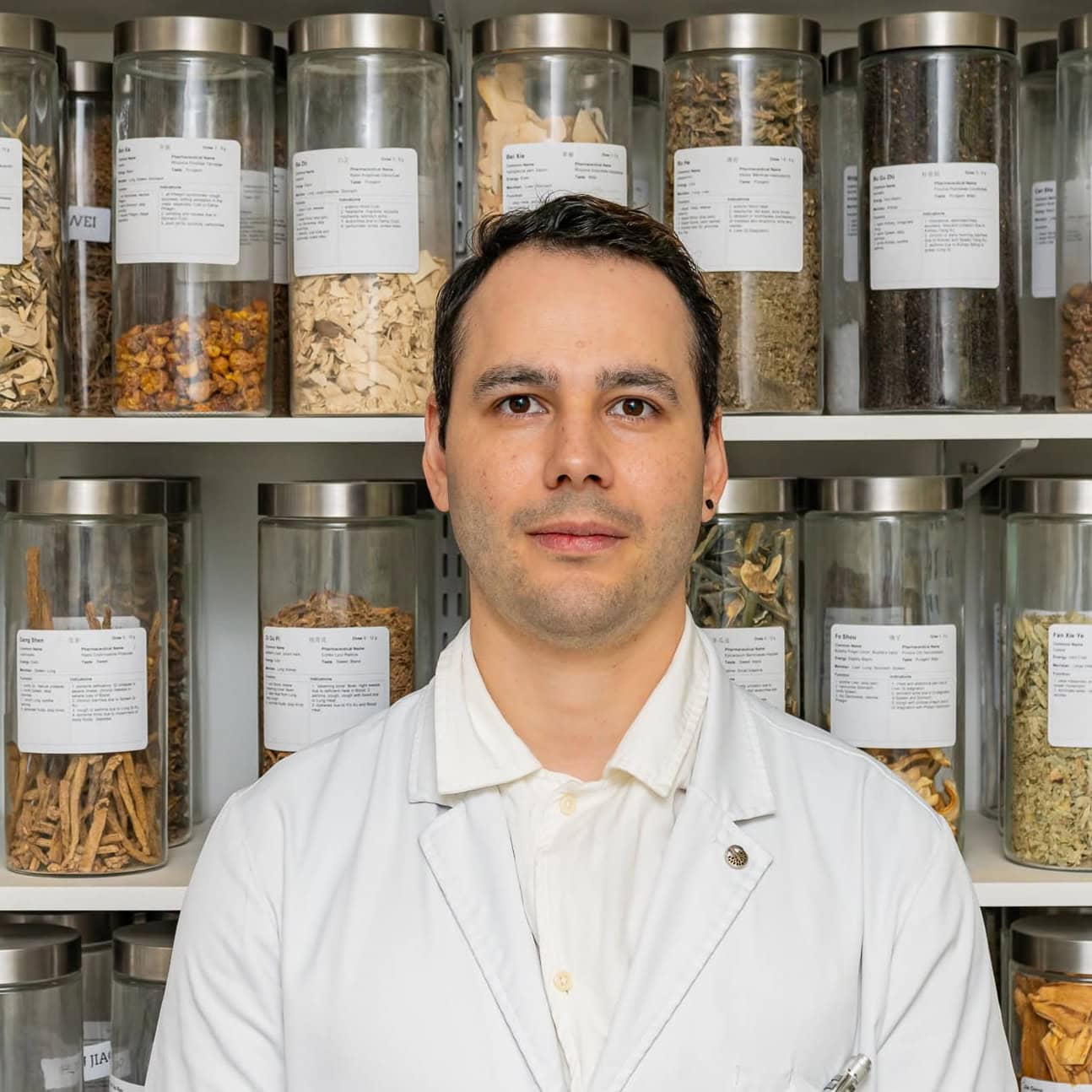
Dr. Henry Tarazona B.TCM, M.TCM, PhD

Dr. Henry Tarazona is one of the few physicians worldwide who holds a Bachelor’s, Master’s, and PhD in Traditional Chinese Medicine from the University of Tianjin of Traditional Chinese Medicine. He is currently settled in Colombia, where he works as an instructor for OCTCM and serves as an Assistant Professor at CATHO Medical University in Vietnam.

His academic and clinical focus centers on the gut–mind connection and its relationship with chronic and complex diseases, integrating Traditional Chinese Medicine theory with modern research. His work is grounded in both scientific investigation and extensive clinical practice, particularly in the management of chronic and complicated conditions.

Links and Resources

Follow Henry Tarazona on Instagram for more insights.

Member Only Content

This additional content is available to members of our podcast.

Explore Similar Podcasts

Subscribe to the Qiological Podcast in Your Favorite Player

You don't have access to purchase this item.